

Are Online Clothing Photos Accurate? A Shopper's Guide
Table of Contents
- Why Online Clothing Photos Look Different From Reality
- How to Tell If Online Clothing Is Good Quality From Product Images
- Understanding Online Clothing Color Accuracy in Product Photos
- How to Judge Clothing Fit From Model Photos
- How to Read Clothing Reviews Before Buying Online
- Building a Checklist for Trustworthy Clothing Product Photos
- What to Do When Online Clothing Doesn't Match the Photos
- Frequently Asked Questions
Last Updated: October 16, 2026
Why Online Clothing Photos Look Different From Reality
The gap between what you see online and what arrives at your door is real, online clothing photos accurate representation requires understanding the techniques behind professional product photography. Lighting, angles, styling, and photo editing all play a role.
Here's what happens behind the scenes. A photographer positions the garment under controlled lighting. They adjust the fabric, smooth out wrinkles, and sometimes use pins or tape to shape it perfectly. The camera captures this ideal version. Then comes retouching, colors get enhanced, minor flaws disappear, and the final image looks polished and appealing.
The problem isn't deception. It's that online clothing product photos accurate representations are created with professional techniques that real-world conditions don't replicate. Your home lighting differs. Your body moves differently than a model or mannequin. Fabric behaves differently depending on fit, fabric type, and how you wear it.
Understanding this gap helps you shop smarter. You learn to read beyond the main product photo. You check multiple angles, zoom in on details, and cross-reference customer reviews.
How to Tell If Online Clothing Is Good Quality From Product Images
Quality clues hide in plain sight on a product page. You don't need to be an expert to spot them. Look for consistent stitching, even seams, and secure closures. Check whether hems are straight and whether the fabric appears uniform in color and texture.
What to examine in detail shots:
- Seams should be straight and even, not puckered or loose
- Stitching should follow a consistent pattern with no loose threads
- Zippers and buttons should sit flat and align properly
- Hems should be level and not frayed
- Fabric texture should appear consistent across the garment
Many online retailers now offer close-up photos specifically for this reason. These detail shots reveal construction quality that main product photos can't show. If a listing skips detail photos entirely, that's worth noting, it may mean the retailer isn't highlighting craftsmanship.
Fabric texture matters too. A fuzzy fabric should look fuzzy in the photo. A smooth fabric should appear smooth. If the fabric looks unnaturally perfect or plastic-like, that might signal heavy editing rather than accurate representation.
Pay attention to how the garment drapes. Quality clothing hangs smoothly. Cheap fabric bunches or clings awkwardly. You can often see this difference in how the garment sits on a model or mannequin, especially around the shoulders, waist, and hips.
Understanding Online Clothing Color Accuracy in Product Photos
Color is where online clothing photos accurate representation gets tricky. What you see on your screen depends on your monitor, your lighting, and the photographer's choices.
Most retailers know this problem exists. The better ones show the same garment under different lighting conditions. Some display it on multiple models with different skin tones.
How to assess color accuracy:
- Compare the product photo to the color description in the listing
- Look for multiple photos of the same garment in different lighting
- Check if the retailer shows the item on models with varying skin tones
- Read customer reviews specifically for color feedback
- Note whether reviewers mention color differences from the photo
Fabric type affects how color appears too. A matte fabric reflects light differently than a shiny one. Cotton looks different from polyester. The material's finish changes how the color reads in a photo and in person.
White balance is crucial here. A photo with poor white balance makes colors look off. Professional retailers invest in proper lighting and color correction.
When you're considering an online clothing purchase, color accuracy matters for fit and confidence. If you're unsure, look for customer photos. Many retailers now allow verified buyers to upload their own images.
How to Judge Clothing Fit From Model Photos
Model photos show how a garment is meant to fit, but models aren't you. They have specific body types, heights, and proportions. A garment that fits one model perfectly might fit you differently.
Start by reading the size information. Does the listing say what size the model is wearing? How tall is the model? What's their typical size range? This context matters.
How to evaluate fit from model photos:
- Note the model's height and size to compare with your own
- Look for fitted areas, shoulders, chest, waist, to see how snug the garment is
- Check sleeve length relative to the model's arm length
- Observe how fabric drapes at the hips, thighs, and legs
- Look for any pulling, bunching, or gapping at seams
- See whether the garment skims the body or clings to it
Flat-lay photos show garment shape differently. When clothing lies flat, you see true dimensions. Width at the chest, length from shoulder to hem, and overall silhouette become clear.
Mannequin photos offer another angle. They show garment shape without the variation of a human body.
Back views matter. Many fit problems show up from behind. Gaping at the back of a shirt, pulling across the back of pants, or an uneven hem all appear in back photos. Don't skip them.
Multiple size comparisons help too. If a retailer shows the same garment in sizes small, medium, and large side by side, you see how it changes across sizes.
How to Read Clothing Reviews Before Buying Online
Customer reviews are your window into real-world experience. They tell you what online clothing product photos accurate representations might miss. Real people describe how garments fit their bodies, how colors actually appear, and how well they hold up.
Look for reviews that mention specific details. "Great quality" helps less than "seams are strong and stitching is even after five washes." Detailed reviews give you actionable information.
What to look for in reviews:
- Fit comments: Does it run small, large, or true to size?
- Color accuracy: Does the color match the photo or differ significantly?
- Fabric feel: Is it soft, stiff, scratchy, or comfortable?
- Durability: How does it hold up after washing and wearing?
- Body type feedback: How did it fit different body types?
- Sizing comparisons: "I usually wear a medium in Brand X, and this medium fit perfectly"
- Wear and care: Any special washing instructions or care issues?
Pay attention to the number of reviews and their overall rating. A garment with 200 five-star reviews is more reliable than one with three reviews. But also check for patterns.
Read mixed reviews carefully. One-star reviews that say "not as described" deserve attention. But also consider whether the reviewer's expectations were realistic. Someone complaining that a casual cotton shirt isn't formal-wear level quality might not be a reliable source.
Look for reviews from people similar to you. If you're a plus-size shopper, find reviews from other plus-size customers. If you have specific concerns about fit or fabric, seek out reviewers who address those concerns.
Verified purchase badges matter. Reviews from people who actually bought and received the item carry more weight than speculation.
Building a Checklist for Trustworthy Clothing Product Photos
Not all product photos are created equal. Some retailers invest heavily in accurate representation. Others cut corners. You can learn to spot the difference.
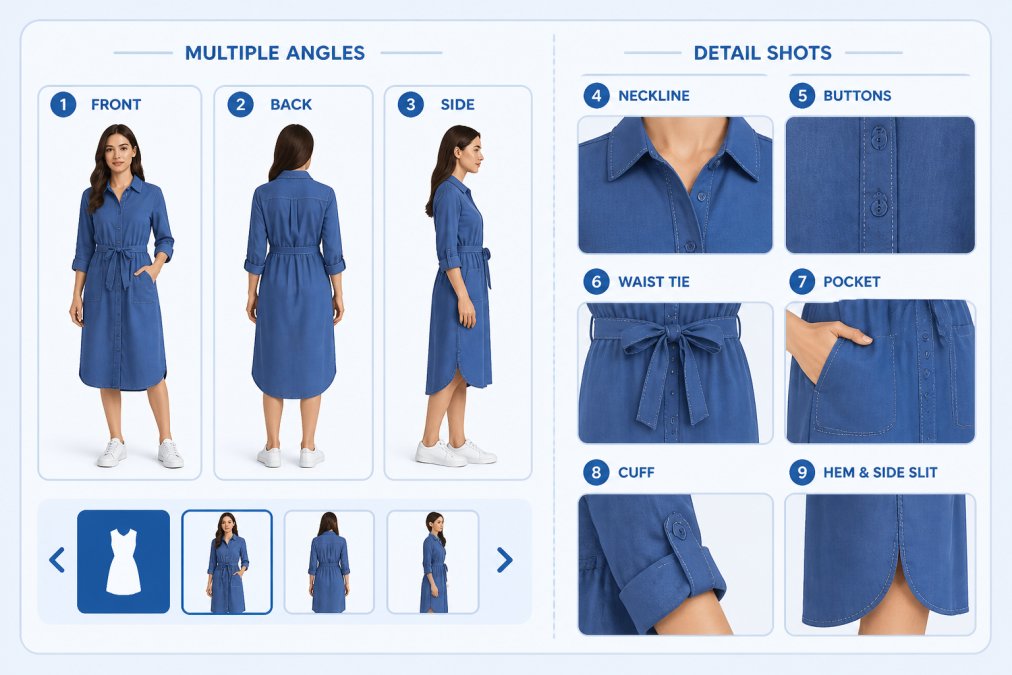
A trustworthy product photo includes multiple angles. Front, back, and side views show the garment's true shape. Detail shots reveal construction quality. This investment signals that the retailer cares about accuracy.
Your checklist for trustworthy photos:
- Multiple angles shown (front, back, side views)
- Close-up detail shots of seams, stitching, and closures
- Consistent lighting and color across all photos
- Model height and size information provided
- Same garment shown on multiple models or body types
- Flat-lay photos showing true garment dimensions
- No obvious signs of heavy editing or unrealistic perfection
- Color swatches or multiple lighting conditions for color accuracy
- Customer photos or reviews visible on the page
- Clear size chart with actual measurements
- Fabric content and care instructions clearly listed
Retailers that provide this level of detail are betting on customer satisfaction. They know that accurate photos reduce returns and build trust.
Be skeptical of pages with only one or two photos. Missing back views, no close-ups of construction, and no size information all suggest the retailer isn't prioritizing accuracy.
Watch for overly polished photos that look almost unreal. Some editing is normal. But if every stitch looks perfect and the fabric has an artificial sheen, that's a sign the image has been heavily altered.
What to Do When Online Clothing Doesn't Match the Photos
Sometimes despite your best efforts, what arrives doesn't match what you expected. Here's how to handle it.
First, document the difference. Take photos of the garment as received. Compare them to the product listing photos. Note specific differences: color, fit, construction quality, or fabric feel.
Check the return policy before you buy. At Chrissy's Eye, we make returns straightforward. You deserve to know exactly what your return options are before you commit to a purchase.
If the garment doesn't match the photos:
- Contact customer service with specific details and photos
- Explain clearly how the item differs from the listing
- Ask about return or exchange options
- Keep all original packaging and tags
- Follow the return process carefully
- Take photos of the item being returned as proof
Most legitimate retailers want to know when photos don't accurately represent products. It helps them improve.
Sometimes the issue is expectation rather than accuracy. The garment matches the photo but doesn't fit your body the way you hoped. That's different from a mismatch.
Keep records of your communication. Screenshots of the original listing, photos of what arrived, and emails back and forth all matter if you need to dispute a charge or file a complaint.
Shopping for clothing online doesn't have to feel like a gamble. When you know what to look for in product photos, how to read reviews, and what your rights are, you shop with confidence.
Frequently Asked Questions
Why do online clothing product photos often look different from the actual garment?
Online clothing photos differ from reality for several reasons. Professional lighting, styling, and image editing enhance the appearance. Models may wear different sizes or have different body shapes than you. Fabric texture, color, and drape appear different under studio lights versus natural daylight. Camera angles, padding, and how garments are pinned or steamed also affect the visual presentation. Retailers want photos to look appealing, so they optimize lighting and retouching, which can make colors appear more vibrant and fit appear more flattering than the garment actually is in person.
How can I verify clothing fit and sizing beyond just looking at model photos?
Check the detailed size chart provided on the product page and compare it to garments you already own that fit well. Read customer reviews specifically mentioning fit, look for comments about whether the item runs small, large, or true to size. Pay attention to reviews from shoppers with similar body types to yours. Look for photos uploaded by customers wearing the garment, as these show real-world fit without professional styling. Check if the retailer offers free returns or exchanges, which gives you confidence to order and try the garment yourself. Contact customer service with specific fit questions before purchasing.
What should I look for in clothing reviews to judge if product photos are accurate?
Look for reviews that mention specific details: whether colors matched the photos, how the fabric felt in person, and whether the fit matched expectations. Reviews mentioning 'exactly as pictured' or 'photos are misleading' give direct feedback on accuracy. Pay attention to the number of returns or complaints about fit and color. High-quality reviews often include customer photos showing the garment worn or laid flat, which reveal how the apparel actually looks versus the product listing. Reviews mentioning fabric quality, seams, lining, and construction details suggest the reviewer examined the garment carefully. Prioritize recent reviews, as product batches and photography can change over time.
How can I tell if an online clothing photo has been edited or retouched?
Look for signs of over-editing: colors that seem unnaturally vibrant, fabric that appears too smooth or wrinkle-free, or unrealistic shine on materials. Check if the garment looks stiff or unnatural in its drape, genuine fabric folds and moves. Compare multiple photos of the same item; if the color shifts dramatically between angles, that suggests inconsistent lighting or heavy editing. Examine seams, labels, pockets, and closures closely, genuine product photography shows these details realistically. If the model's skin appears airbrushed or the background looks blurred artificially, the retailer may be over-editing. Cross-reference with customer reviews and photos to see how the garment actually looks.