

How to Find Plus-Size Clothes That Actually Fit
Last Updated: November 1, 2026
Quick Summary
Plus-size clothes fit differently because they are drafted from a separate base pattern and graded with different rules, not simply scaled up from straight sizes. This means plus-size fit depends on a brand's pattern block, grading increments, and fabric, so the same label can describe two very different garments.
- Plus pattern blocks adjust bust apex, armhole depth, waist-to-hip ratio, crotch depth, and sleeve cap height.
- A size chart listing only bust, waist, and hip tells you nothing about thigh or bicep room.
- Measure over light clothing, keep the tape level, and use the larger number if two readings differ.
- Size charts list body measurements, not garment measurements; the gap between them is called ease.
- 2XL and XXL come from different sizing systems, so check garment measurements instead of the letter label.
Table of Contents
- Why Plus-Size Clothes Fit Differently From Straight Sizes
- Plus-Size Pattern Grading: Why Sizing Up Isn't the Same as Fitting
- How to Measure for Plus-Size Clothing at Home
- Reading a Plus-Size Clothing Size Chart the Right Way
- 2XL vs XXL: Why the Same Label Means Different Things
- How Fabric Stretch, Weight and Construction Change the Fit
- Troubleshooting Fit by Garment Area: Bust, Waist, Hips and Thigh
- Building a Fit-First Shopping Habit at Chrissy's Eye
- Frequently Asked Questions
Why Plus-Size Clothes Fit Differently From Straight Sizes
That is the core idea behind this guide. Plus-size fit is its own discipline, not a stretched-out version of missy sizing.
Here is what most guides get wrong: they blame your body. In practice, the mismatch usually comes from the garment.
Straight sizes and plus sizes start from separate base patterns and pattern blocks.
So the same number on two labels can describe two completely different garments. Once you understand that, shopping gets a lot less frustrating.
Plus-Size Pattern Grading: Why Sizing Up Isn't the Same as Fitting
Pattern grading is the process of increasing or decreasing a base pattern across a size range. Garments in a plus range can be built from a separate plus pattern block, and grading that block across sizes is one reason plus-size fit differs from straight-size fit.
That difference explains the strange fit you feel in the dressing room. A garment can be "your size" on paper and still gap at the bust, pull at the hip, or hang loose at the shoulder.
What a Plus Pattern Block Changes Before Grading Even Starts
- Bust apex and dart placement: positioned for a fuller bust and often a lower apex
- Armhole depth and shoulder slope: shaped so the sleeve does not bind or droop
- Waist-to-hip ratio: drafted with more curve through the midsection and seat
- Crotch depth and rise: extended for body depth, not just circumference
- Sleeve cap height: lowered so the upper arm has room to move
What Grading Rules Actually Change Between Sizes
Grading rules decide how each measurement grows from size to size, and they vary between brands.
- Waist: plus grading often adds more room here than straight grading does
- Hips: hip increments tend to be larger in plus ranges
- Thigh: a measurement many size charts never list, but it decides comfort
- Bicep: sleeve openings need extra room, or the arm feels tight
- Rise: the distance from crotch to waistband changes with body depth
Why Two People With the Same Measurements Need Different Cuts
Grading assumes an average body within each size, but bodies vary in where they carry weight. Two shoppers can share identical bust, waist, and hip numbers and still need different cuts because of torso length, bust shape, and weight distribution. A pear-shaped body needs hip and thigh room that an apple-shaped body does not, and a long torso changes where a waistband actually lands.
How to Measure for Plus-Size Clothing at Home
Learning how to measure for plus-size clothing takes about ten minutes and saves you a lot of returns. You need a soft tape, a mirror, and someone to help with the back measurements if you can.
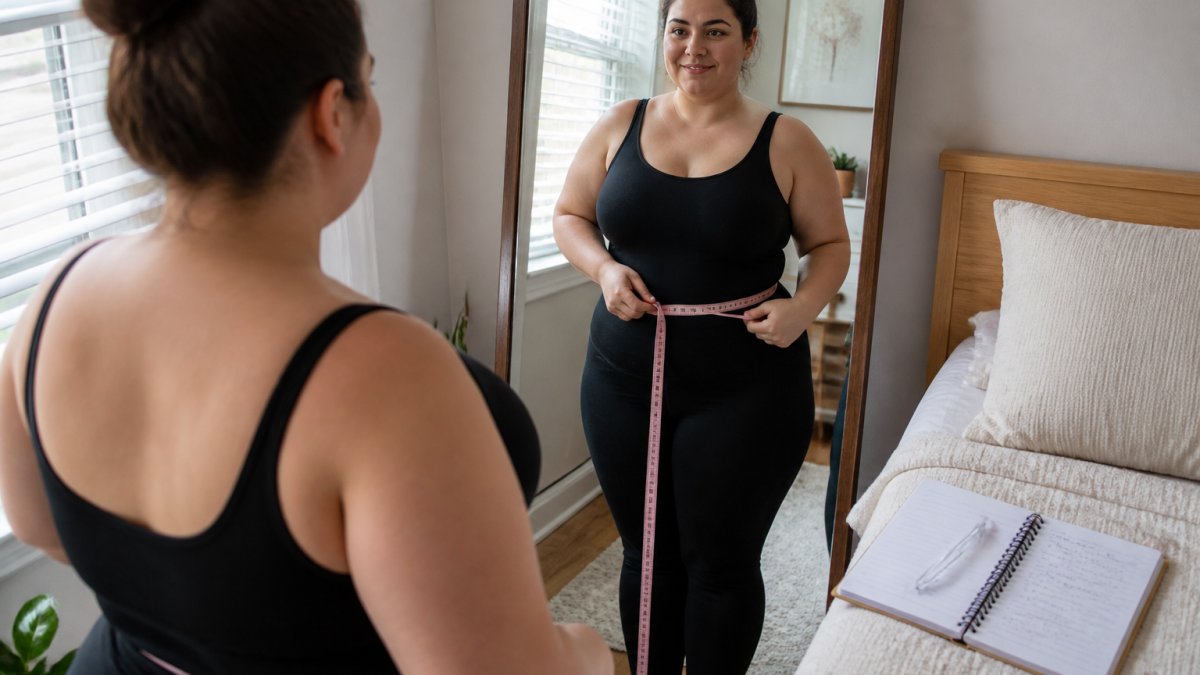
Measure over light clothing, keep the tape level, and do not pull it tight. Write each number down as you go.
- Bust: around the fullest part, tape level under the arms
- Waist: at the narrowest point of your torso, usually above the navel
- Hips: around the fullest part, roughly 20 cm below the waist
- Thigh: around the fullest part of the upper leg, standing
- Bicep: around the fullest part of the upper arm, relaxed
- Inseam: from crotch to ankle bone along the inside leg
- Torso length: from shoulder to waist, for tops and dresses
Take each measurement twice. If the numbers differ, use the larger one.
Reading a Plus-Size Clothing Size Chart the Right Way
A plus-size clothing size chart lists body measurements, not garment measurements. That single fact clears up most sizing confusion.
Body measurements describe you. Garment measurements describe the clothes. The gap between them is called ease.
Body Measurements vs Finished Garment Measurements
Finished measurements are taken flat across the actual garment. Compare them to your body measurements to see how a piece will sit.
Here is a common rule of thumb:
- Positive ease: the garment is larger than your body, which gives a relaxed look
- Negative ease: the garment is smaller than your body, which gives a close fit
- Zero ease: the garment matches your body exactly
A knit top with negative ease will stretch to fit. A woven blouse with zero ease may not. Check the fabric before you trust the number.
Watch out: a size chart measured on a flat garment can read 5 cm smaller than the same chart measured around the body. Confirm which method the brand uses before you order.
2XL vs XXL: Why the Same Label Means Different Things
2XL and XXL are not interchangeable. Both mean "extra extra large" in theory. In practice, they come from different sizing systems, and each brand sets its own numbers behind them.
Elegant, solid color women's plus size Blouse →
The 2XL vs XXL problem comes down to three things:
- Different scales: some brands run 1X, 2X, 3X; others run XL, XXL, XXXL
- Different base patterns: the two systems start from separate blocks
- Vanity sizing: labels drift over time as brands flatter shoppers with smaller numbers
Vanity sizing is the quiet culprit. A size label is a marketing decision as much as a technical one. Two brands can both call a garment "2XL" and mean two different bodies.
A practical approach: check the garment measurements rather than relying on the letter label alone.
How Fabric Stretch, Weight and Construction Change the Fit
Fabric decides whether a garment forgives a small mismatch or exposes it. Two tops in the same size can fit completely differently based on what they are made of, and on a fuller figure, those differences compound because there is more surface area for a fabric to cling, pull, or sag.
Stretch and Stretch Recovery
Fabric stretch is how far a material gives; stretch recovery is how well it snaps back. A high-stretch, poor-recovery knit feels comfortable in the fitting room and baggy by mid-day. A moderate-stretch, good-recovery knit holds its shape through wear.
A common pattern: knits with a high elastane content recover better but can feel compressive, while cotton-rich knits feel softer but relax over time. Neither is wrong, they suit different styles.
Fabric Weight and Drape
Fabric weight determines how a garment hangs. Heavier knits and wovens drape and hold shape; light ones cling and show every seam line. Plus-size garments use more fabric, so weight and drape matter more. A light knit that skims a straight-size frame can cling on a fuller figure, while a mid-weight woven skims without sticking.
Construction Details That Affect Fit
- Seam allowance and stitching: generous seams give a garment structure; narrow, overlocked seams can pull and pucker under tension
- Lining: a lined garment hangs more smoothly and hides seam lines, but adds bulk and reduces stretch
- Darts and princess seams: shaped seams follow the body's curve instead of cutting straight across it
- Waistbands: elastic, flat-front, or drawstring each distribute pressure differently across the midsection
- Manufacturing tolerances: small production variations exist between batches, so two units of the same size can differ by a centimeter or more
You can see this principle at work in a loose-fit plus-size blouse, where the cut and knit fabric do the fitting work rather than the size label.

Troubleshooting Fit by Garment Area: Bust, Waist, Hips and Thigh
Fit problems usually show up in the same four places. Match the symptom to the fix.
| Problem Area | What You Notice | Likely Cause | What to Do |
|---|---|---|---|
| Bust | Gaping at the button placket | Negative ease at the bust | Size up or choose a stretch knit |
| Waist | Fabric pulls or rides up | Waist graded too small | Look for an elastic or high waist |
| Hips | Tight across the seat | Hip increment too small | Check finished hip measurement |
| Thigh | Fabric clings or rubs | Thigh not graded at all | Choose a stretch fabric with room |
| Bicep | Sleeve feels tight | Sleeve opening not graded | Pick a drop shoulder or looser sleeve |
If hip and thigh room is your main struggle, a pair of high-waisted plus-size leggings with pockets built with high stretch shows how the right fabric and rise solve both problems at once.
Watch out: sizing up to fix a tight hip often leaves the shoulders and bust too big. Fix the area that fails first, not the whole garment.
Building a Fit-First Shopping Habit at Chrissy's Eye
Fit-first shopping is a habit, not a one-time fix. Keep your measurements in your phone. Check the size chart every time, even for brands you know.
At Chrissy's Eye, our goal is a relaxing, stress-free shopping experience, with warm and friendly service. We carry women's, men's, plus-size, and big and tall apparel in one place.
You can browse an elegant solid-color plus-size blouse or a V-neck button-down blouse with irregular stripes to get a sense of our range.


Frequently Asked Questions
Why do plus-size clothes fit differently from straight-size clothes?
Plus-size garments are cut from a graded pattern, not simply scaled up from a straight-size block. As sizes increase, the body does not grow evenly: hips and thighs often gain more circumference than the bust, and the waist-to-hip ratio shifts. Brands that grade by adding a fixed amount at every point produce a garment that fits one body shape well and pulls or gapes on another. Fabric stretch, seam allowance and manufacturing tolerances add further variation, which is why two size 2XL tops can feel completely different.
What is the difference between 2XL and XXL?
There is no industry-wide standard, so 2XL and XXL are not guaranteed to be the same measurement. Some brands use XXL as their second size above XL, while others treat 2XL as the start of a separate plus range with a different base pattern and more room through the hip and bicep. Always check the plus-size clothing size chart for that specific brand and compare the bust, waist and hip numbers in centimetres rather than trusting the label.
How do I find my size when shopping for plus-size clothes online?
Measure yourself with a soft tape over light clothing, keeping the tape level and snug but not tight. Record bust, waist, hip, thigh and bicep, then compare those numbers to the brand's plus-size clothing size chart. Where a product page lists finished garment measurements, subtract your body measurement to see how much ease the piece has. If you land between two sizes, choose based on fabric stretch: high-stretch knits can go down, woven fabrics should go up.
How do fabric and garment construction affect plus-size fit?
Fabric changes how a garment behaves once it is on. High-stretch knits with good stretch recovery move with the body and forgive small grading differences, while stiff wovens with little give show every variation. Fabric weight matters too: light drapey fabrics skim curves, heavier fabrics hold structure. Construction details such as seam allowance, dart placement and where the waist seam sits all affect whether a piece feels true to size, so read the material description before you order.
Fit confusion is not your fault, and it is not something you have to live with. Chrissy's Eye makes the numbers easy to find, keeps our size range broad across women's, men's, plus, and big and tall, and backs it with friendly customer service that answers real sizing questions. Get started with Chrissy's Eye and shop your actual measurements, not a label that changes from store to store.
